The most common watering mistake is the one that feels most responsible: a quick sprinkle every evening through a dry spell. It seems caring. It’s actively harmful. Light daily watering keeps moisture in the top centimetre of soil, so the grass roots stay up there where the water is, never developing the deep root system that lets a lawn survive a real drought. You’re training the lawn to be fragile, then wondering why it browns the moment you go on holiday.
A lawn watered correctly becomes more drought-resistant over time. A lawn watered the common way becomes more drought-dependent. Same hosepipe, opposite outcomes. The difference is entirely in how much and how often.
Does a UK lawn even need watering?
Often, no. This is worth saying before anything else, because the British climate does most of the work most of the time, and a lot of lawn watering is unnecessary effort and metered water down the drain.
An established lawn in the UK survives almost every summer without any watering at all. It will go brown and dormant in a prolonged dry spell — and that brown is alarming if you haven’t seen it before — but dormancy isn’t death. The crowns and roots stay alive underground, and the lawn greens up within a fortnight of rain returning. A lawn that browned in a July heatwave is usually lush again by September without you lifting a finger.
So the first honest question isn’t “how do I water” but “do I need to.” For most established lawns, watering is a choice about appearance, not a necessity for survival. If you can live with a few weeks of brown in a hot summer, you can skip watering entirely and the lawn will be fine.
There are situations where watering genuinely matters, though:
New lawns from seed or turf need consistent moisture for the first six to eight weeks while they establish — that’s not optional, and we cover it in the laying a lawn from seed guide. Lawns you’ve just overseeded or renovated need the same. And if you simply want a green lawn through summer rather than a dormant brown one, watering is how you get it. That’s a legitimate want; just understand it’s an aesthetic choice with a water bill attached, not a rescue mission.
How much water, actually
When you do water, the rule is simple and almost everyone gets it wrong in the same direction: water deeply and infrequently, never lightly and often.
A lawn needs roughly 25mm of water per week to stay green through dry weather, delivered in one or two soakings rather than seven sprinkles. That 25mm figure includes rainfall — if it rained earlier in the week, you water less or not at all.
The reason deep-and-infrequent works comes down to roots. Water that penetrates 15cm down draws the roots downward to follow it. Deep roots reach moisture that surface roots can’t, so the lawn stays green longer between waterings and survives dry spells far better. Shallow, frequent watering does the opposite — the roots cluster near the surface where the water is, and that surface layer is exactly the part that dries out first and fastest.
So: one good soak a week that wets the soil to 15cm beats seven light sprinkles every time, even though the light sprinkles feel more attentive.
Working out how long that takes
“25mm of water” isn’t much use if you don’t know how long your sprinkler runs to deliver it. The tuna-tin method sorts this out in one session and you never have to think about it again.
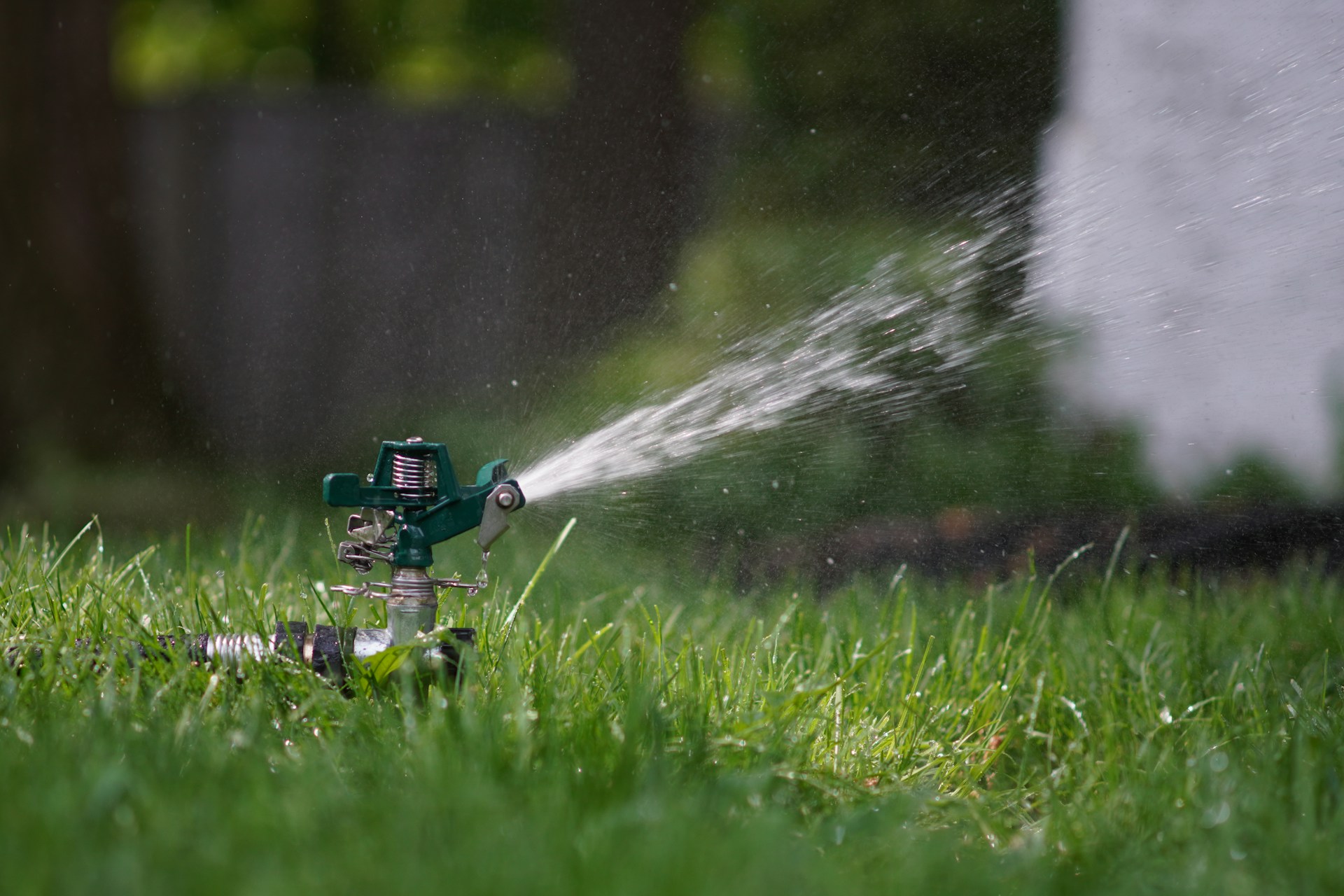
Put a few empty tins (tuna or cat-food tins, straight-sided, all the same size) around the lawn within the sprinkler’s reach. Run the sprinkler for 30 minutes. Measure the water depth in the tins with a ruler. If you’ve collected 12mm in 30 minutes, then reaching 25mm takes about an hour. Now you know your number — for most domestic sprinklers and pressures it lands somewhere between 45 and 90 minutes for a full soak.
This also reveals coverage problems. If the tins nearest the sprinkler are full and the far ones are nearly empty, your sprinkler isn’t covering evenly and you’ll need to reposition it partway through, or accept patchy results.
When to water
Early morning, before about 9am, is the clear best time. The water soaks in before the day’s heat evaporates it, and the grass blades dry through the day, which matters because grass that stays wet overnight is far more prone to fungal disease.
Evening is the second-best option if mornings genuinely don’t work for you, but it carries that disease risk — wet grass sitting through a cool night invites problems like red thread and fusarium. If you must water in the evening, do it early enough (before 7pm in summer) that the blades dry a little before nightfall.
Watering in the middle of a hot day is the worst option and a genuine waste. Much of it evaporates before reaching the roots, and the rapid temperature change on hot blades can stress the grass. The old myth about water droplets acting as magnifying glasses and scorching the grass isn’t true, but midday watering is still inefficient enough to avoid.
The dormancy decision
In a serious dry spell, you face a real fork: commit to watering or commit to letting the lawn go dormant. The one thing you must not do is dither between them.
If you choose to water, keep it up consistently through the dry period — that weekly deep soak, without long gaps. If you choose dormancy, stop watering and let the lawn go properly brown, then leave it alone.
The damage comes from flip-flopping. A lawn that’s allowed to go dormant has shut down to protect itself; a sudden burst of water can break that dormancy and trigger fresh growth, which then has no water to sustain it when you stop again. That repeated waking-and-starving stresses the grass far more than honest dormancy ever would. Pick a lane and stay in it for the duration of the dry spell.
For most people most years, dormancy is genuinely the right choice — it’s free, it’s natural, and the lawn recovers fully when rain returns. Watering through a drought is for those who specifically want a green lawn and accept the cost and effort that comes with it.
A few watering myths worth dropping
A daily light sprinkle is good for the lawn. It’s the opposite — it builds shallow roots and a fragile lawn, as covered above.
Brown means dead. Usually it means dormant. Established UK lawns recover from summer browning once rain returns; give it two weeks before assuming the worst.
You need an irrigation system. For a domestic UK lawn, a movable sprinkler on a hose, used correctly a handful of times a summer, is plenty. Installed irrigation is expensive and rarely justified for a typical garden in this climate.
More water is always better. Overwatering is a real problem — it drives out soil oxygen, encourages shallow roots and moss, and invites disease. Waterlogged lawns suffer as much as dry ones, just differently.
What actually builds a drought-proof lawn
The genuine long game isn’t about watering technique at all — it’s about building a lawn that barely needs watering in the first place.
Mowing higher is the biggest lever. Grass kept at 4-5cm rather than scalped short shades its own roots, holds soil moisture, and grows deeper roots. A taller lawn stays green noticeably longer into a dry spell than a closely mown one. Aerating annually lets water penetrate deep instead of running off compacted ground. Improving the soil with topdressing over a few seasons raises its water-holding capacity. And feeding sensibly produces strong grass with deep roots, where overfeeding produces lush, shallow-rooted growth that’s thirsty and weak.
Do those four things over a couple of years and you end up with a lawn that shrugs off the dry spells that would brown a neglected one — and you’ll reach for the hose far less often. The spring lawn care guide covers the mowing and feeding rhythm, and the renovation guide covers the aeration and topdressing that build that resilience from the soil up.
The best-watered lawn, in the end, is the one that’s been built well enough that it hardly needs watering at all.